Eternal links: Lahinch is golf's global village
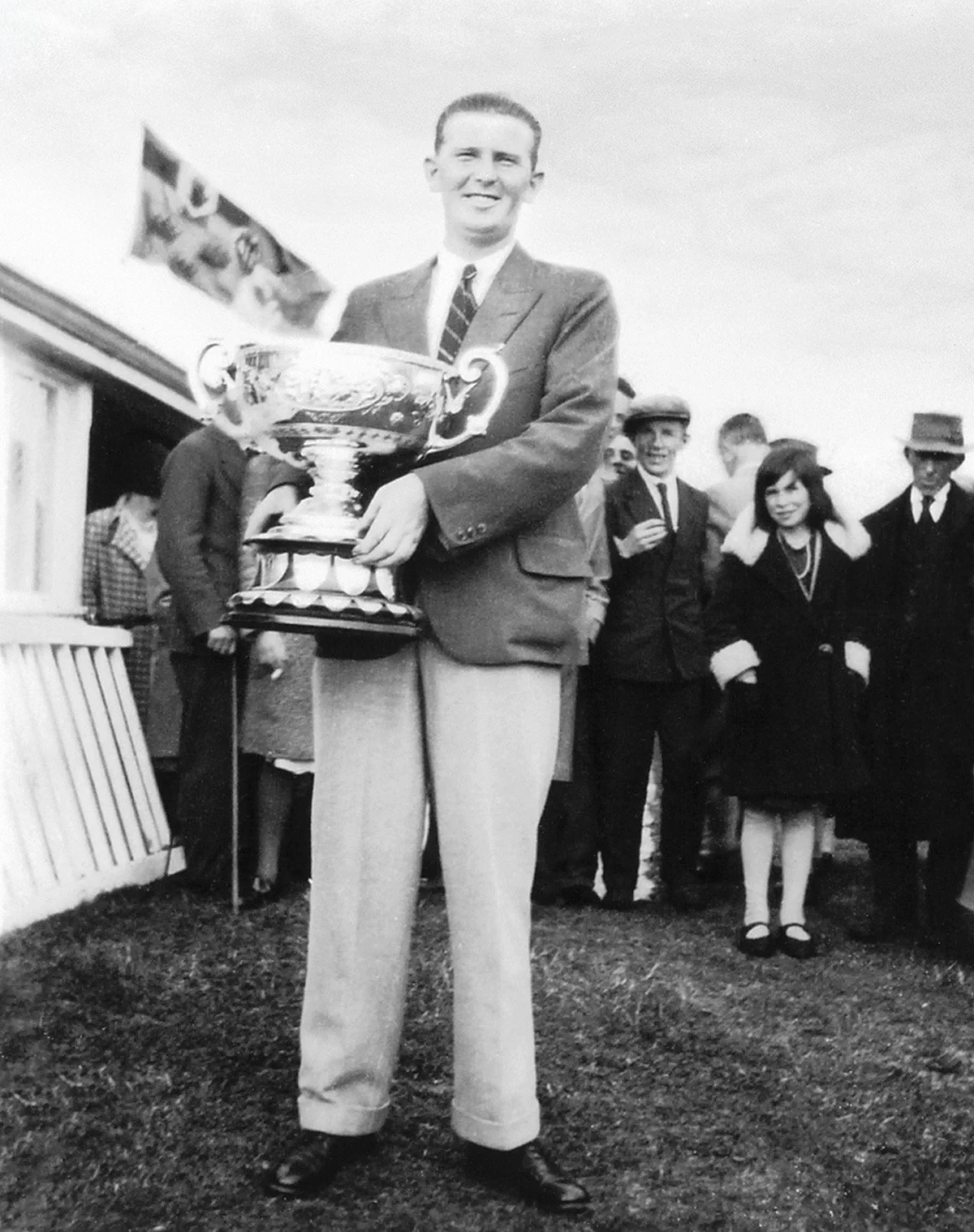
John Burke with the 1930 Irish Close trophy
They say in Lahinch that people come for the golf but return again for the experience. It is as true and undeniable as the beauty of this little corner of west Clare, where golf is part and parcel of everyday life.
As the Walker Cup descends upon the old links this weekend, it's a reminder that while the pro game might drive interest in golf for most TV-watching aficionados, it's amateur golf that at least tries to uphold the game's pure, unadulterated essence.
In an era consumed by LIV's vanishing billions, NIL (Name, Image, Likeness) deals for college golfers and private equity now the ace in the sleeve of the PGA Tour, this week is a defiant reminder that men like John Burke, the King of Lahinch, played for the pure love of the game.
The Walker Cup is not about the village of Lahinch, which will embrace the action with its characteristic warmth and charm, but about what Lahinch represents.
The R&A and the USGA know that golf, at its essence, is a village and that respect for the ghosts of the past is essential to ensuring it remains the game that drove Alexander Shaw, his Limerick colleagues and officers of the Black Watch regiment to found a course at Lahinch in 1892 and drive the enterprise forward.
Two of the original holes, "Klondyke" and "The Dell," still remain as monuments to Old Tom Morris, who laid out the first enduring version of the course in 1894.
They're anachronisms — a par five (par-four this week) where you must hit blind towards the green over an enormous dune and a blind par-three, where a white stone indicates the line of play to a green tucked in the fold between two hills.
Yet it is precisely these quirks that give Lahinch, and golf, its soul.
They're a throwback to a time when matchplay was the great test, and in Burke, who for more than 20 years dominated Irish amateur golf like a colossus and might have played in more than the 1932 Walker Cup at Brookline, had it not been for his Old IRA past, Lahinch had a hero.
As fondly remembered is Burke's great friend Mick O'Loughlin, the Ennistymon butcher whose wit was as sharp as any of his knives.
They started as caddies, sneaking surreptitious games on the links before being invited to become the first locals, not involved in business, to become members of the club in the late 1920s.
It was Burke who shone brightest, and within 18 months, he had won the first of his record haul of eleven South of Ireland Championships, to which he added eight Irish Close crowns, six West of Irelands and the 1947 Irish Amateur Open, where he beat Joe Carr on the 36th at Royal Dublin.
Burke's 1932 Walker Cup appearance at Brookline remains one of golf's great romantic tales. Partnering Bill Stout against Francis Ouimet and George Dunlap, they suffered a 7&6 hiding in the foursomes.
But in the singles against Jack Westland, Burke (the first player from the new Irish Free State to receive a Walker Cup cap) produced the stuff of legend: five down after the morning round, he clawed back to all square by winning the last three holes.
Playing the 18th, his caddie took a six iron from his hands and replaced it with a four. He had a cunning plan, long before Richard Curtis and Rowan Atkinson ever thought of Baldrick.
"Look, John," the caddie said, "there are approximately five thousand people on the back of that sloping green. Play a number four and smack that ball good and hard."
The plan was for the crowd that horseshoed the green to stop the ball and set up an easy par for Burke as Westland tackled a challenging bunker shot.
Burke took the advice but to his horror, his ball soared clean over the heads of the gallery. Yet somehow, he chipped close and halved the match.
Despite these heroics, Burke was never given another Walker Cup cap. He later said that this was because his membership of the 4th Battalion of the Mid-Clare Brigade and his involvement in the deadly 1920 Rineen Ambush near Lahinch during the War of Independence, when six RIC men were killed, was discovered by the British golf establishment.
He was a showman as much as a genius. His great supporter Dicky Harris—father of film star Richard Harris—would place a wristwatch on the tee and have Burke drive balls from its face. "Come watch time fly," he'd say before collecting from those who wagered he couldn't hit it without destroying the watch.
When confined to a wheelchair later in life, Burke was the only person permitted to bring his car onto the links to follow play in the South of Ireland Championship.
If Burke was the king, O'Loughlin was the court jester. His famous exchange with schoolteacher Brud Slattery—who would serve thirty years as club secretary—still echoes through the clubhouse.
O'Loughlin, standing over a crucial putt en route to victory in the 1937 South of Ireland, glowered at Slattery: "Would the schoolteacher on the 18th tee please be quiet while I hole this putt." When Slattery apologised, O'Loughlin confided: "Brud, I was so tense, I could hear the bees farting in the field beyond."
Slattery himself won the South in 1947 by rattling off seven consecutive threes in the final to beat Burke on the 13th. His grandfather was among the landowners who originally leased the land.
These characters were the architects of Lahinch's soul. They played for the love of it, for the craic. There was only the game, the wind off the Atlantic, and the fellowship of the links.
The lineage they established continues through champions like Paul McGinley, who won the South in 1991 and used to caddy for his dad here as a kid. "One of my big memories was going in there and seeing all the photos on the wall of the various finals, thinking that one day I'd like to get my picture up there as well," he says. "And sure enough, it happened."
Darren Clarke won in 1990, Graeme McDowell in 2000—celebrating his twenty-first birthday drinking in Kenny's pub with his friend Ricky Elliott, who now caddies for Brooks Koepka.
The world of golf might have changed beyond recognition, but the connections endure. It's still a village.
Padraig Harrington lost successive South finals before going on to win the Close there in 1995, when he made his third Walker Cup appearance alongside another former South of Ireland winner, Jody Fanagan.
"The greatest thing about Lahinch and the South was that it was a holiday," Harrington recalled. "We used to set off with six or eight of us trying to get into the car."
The caddies of Lahinch are characters in their own right. Noel Neylon was out one day caddying for a hacker who asked, when trudging up the sixth, if a seven-iron would be enough to reach the green. "Eventually," came the exhausted reply.
Perhaps the spirit of it all was best summed up by two-time South winner Rupert De Lacy Staunton, who passed away in May. Reflecting on Greg Young from nearby Kilrush—who lost five South finals, two of them to Rupert—Staunton recalled: "There were bonfires on the hill, ready to be lit, and had Greg won, Lahinch would never have seen anything like it. It would have been the greatest night of my life if Greg had beaten me. Lahinch would have been ablaze."
Golf and Lahinch have changed since the days when Burke was king, but it is still a place where people come for the golf and return for the experience.
A sellout crowd of 8,000 will walk the fairways following the best amateurs in the world this weekend, following in the footsteps of those giants of yesteryear.