Lowry refuses to let the clock run out on magical career
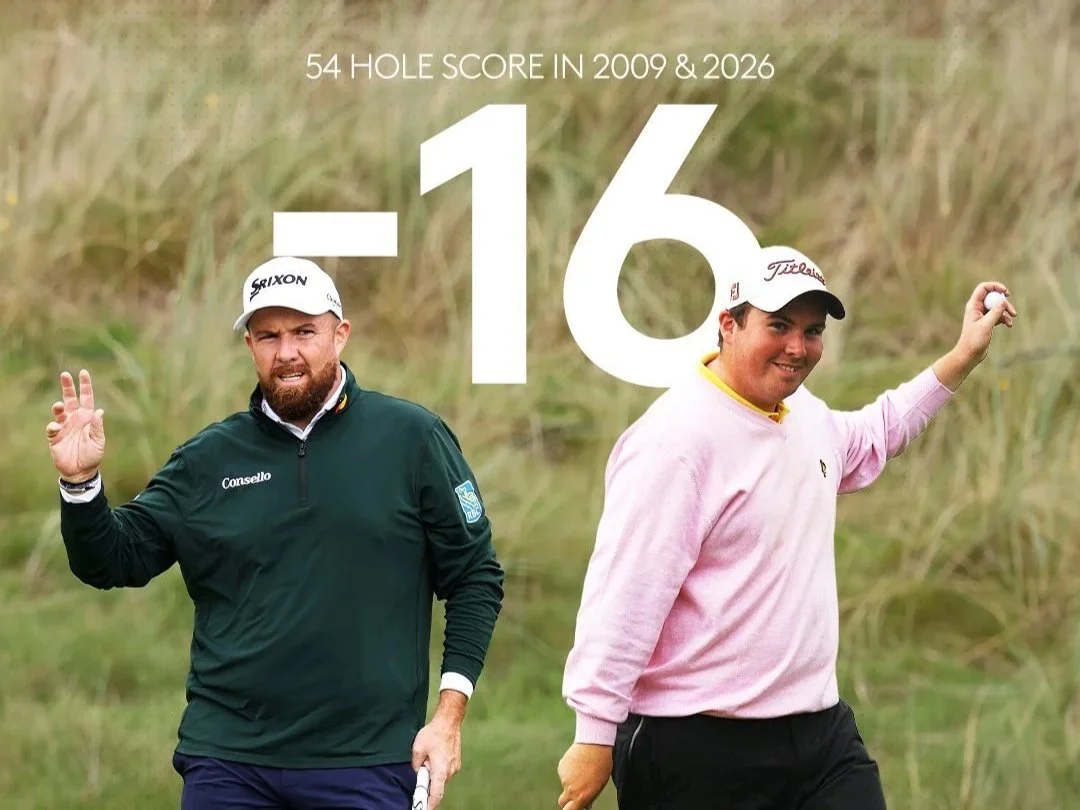
Shane Lowry in 2009 and 2026
Shane Lowry has spent enough time with Pádraig Harrington over the past 18 years to know that time waits for no man in professional sport.
The 39-year-old Offaly man is three months older than Lionel Messi, who drew the curtain on his international career after Argentina's FIFA World Cup final defeat to Spain.
Golfers have a longer shelf-life than footballers, but Lowry has been referring to his age and the ticking clock for quite some time now, and if Sunday's epic Amgen Irish Open win proved anything, it's that he still has runway ahead.
"People don't notice, but you have a 20-year career, and I matched that exactly," 55-year-old Harrington said at Doonbeg last week. "I got my late win after 20 years. I won in 2015, 2016. But the game was really hard for me, really; I was trying so hard. I was going out there, shooting 72, 73, coming in, sitting with young lads at lunch and wondering, Should I be there? I was very much burnt out."
Lowry is far from being burnt out, but he's been patently aware of his golfing mortality for some time, even far back at the 2023 Ryder Cup in Rome.
"I said to the lads last night, I said, we've got a young team," Lowry said in Europe's victory press conference. "Rose is the only player on the team over 40; I'm the second-oldest at 36…"
Failing to make the top 50 in the FedEx Cup makes scheduling more demanding next season, as he won't automatically qualify for the signature events.
But after falling out of the world's top 50 last month for the first time in two and a half years, his record-setting Irish Open win - beating Bernhard Langer's 10-shot margin over Sandy Lyle at Royal Dublin in 1987 —catapults him from 53rd to 41st in the OWGR and back where a golfer needs to be.
It means he just has to remain inside the magic number until December 31 to secure his 12th start at Augusta and the chance to redeem himself after shooting respective final rounds of 81 and 80 in 2025 and 2026 when lying sixth and fourth.
It would have been easy to allow those days to fester and dwell on those disappointing losses in the Dubai Invitational, where he double-bogeyed the 72nd hole, or the Cognizant Classic, where he was three clear with four holes to play and suffered a late meltdown.
While some rely on mental coaches — and Lowry has worked on and off with Dr Bob Rotella — the Offaly man is a team sportsman at heart, and his mini boot camp with his closest confidantes after his FedEx Cup exit proved the difference.
His decision to change caddie after missing the cut at the US Open and go back to Dermot Byrne, who was on his bag for the first decade of his career, also proved vital.
"Obviously it all clicked this week," Lowry said on Sunday night. "But I felt mentally I was in an amazing place this week, as well. I felt like I went out and went after it. I felt like I played somewhat carefree golf, where I wasn't worried about making mistakes. I wasn't worried about the outcome of anything."
The way he approached the final round was pure Rotella.
When Harrington botched the 72nd hole in the 2007 Open Championship at Carnoustie, golf's most successful mental coach told the Dubliner how he wanted him to approach the play-off with Sergio Garcia,
"I want you to run out of holes (in the play-off) like a track man running through the tape," Rotella said. "If a trackman starts slowing down before the tape, he loses time. I want you to just run out of holes and then find out how you did."
Perhaps sensing that this is a watershed period of his career, for all his talk of minor results blips and an underlying trend of good golf, Lowry was a man on a mission all week.
A 349-yard drive and a short iron to 16 feet at the first yielded a birdie that extended his lead to five strokes and he never stopped pushing.
"I said to Neil [Manchip] this morning, maybe I got caught up a couple of times this year of not playing to the final whistle when things happen," he revealed.
"Whether I'm five ahead or five behind, I'm playing to the 18th and we'll see where we are after that. So I did that today."
He was so focused he didn't realise when he made a 10-footer for birdie at the 15th that he was ten clear.
Still, he kept on pressing, determined to burst through the finish line "and give the crowd something to cheer about."
It took over an hour and a half from the time he holed his final birdie putt to seal the biggest margin of victory in Irish Open history for Lowry to complete his round of speeches and media obligations.
He wore the same grin he wore on the first tee at Baltray in 2009, when he teed it up in his first Irish Open as an amateur and went on to win.
He continues to play the same brand of genius, artistic golf, but last week he played with an aggression unusual for a player whose imprimatur is relentless rhythm.
He wasn't Sugar Ray Leonard but Marvin Hagler.
"I said to myself this week, and I don't know why it came into my head, but I said I'm going to go out and go after this tournament," he said. "And I never really think like that, and it really stuck with me all week."