'Maybe we are too far detached from those lads' - Harrington sees peer success as solution to diminishing Irish presence
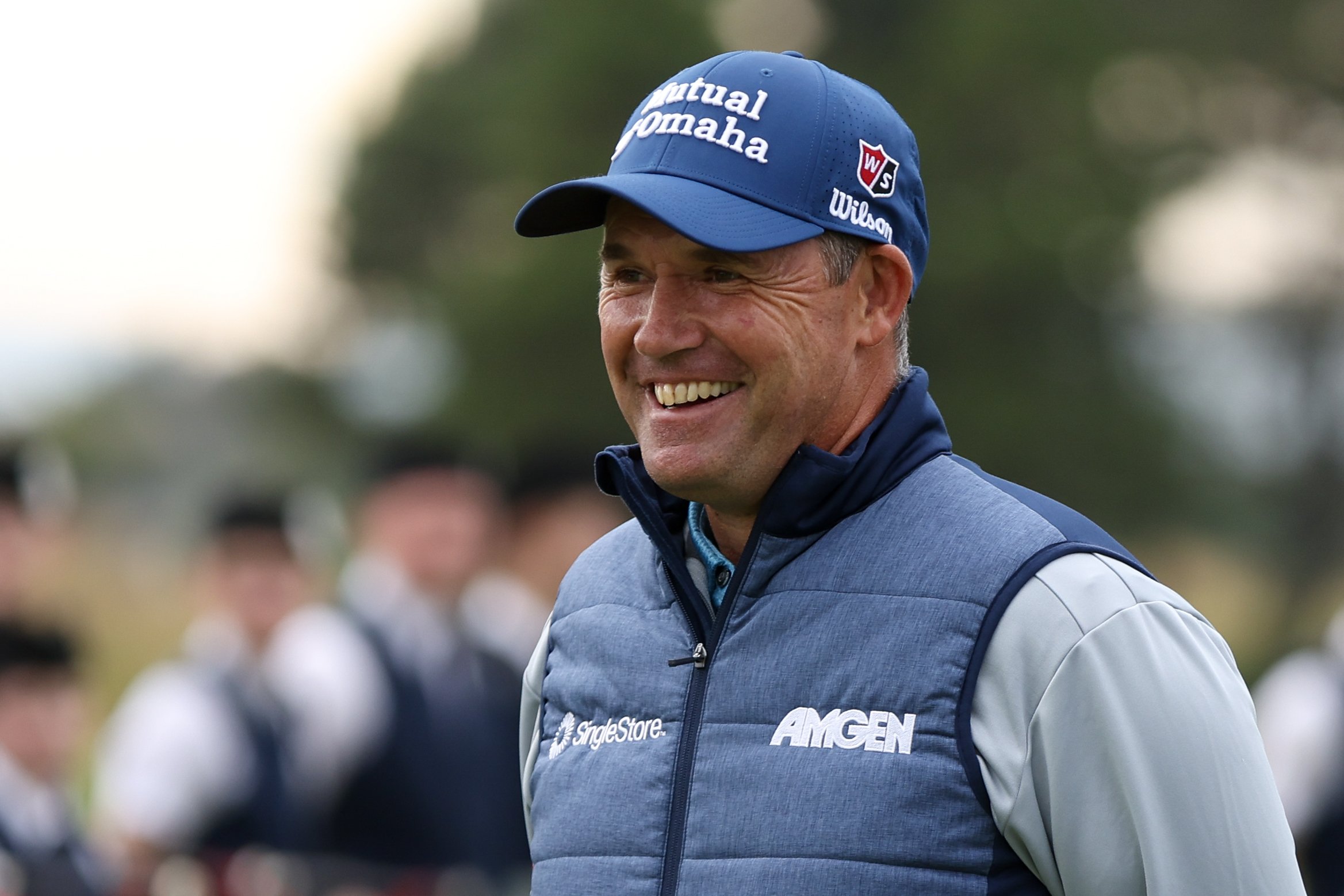
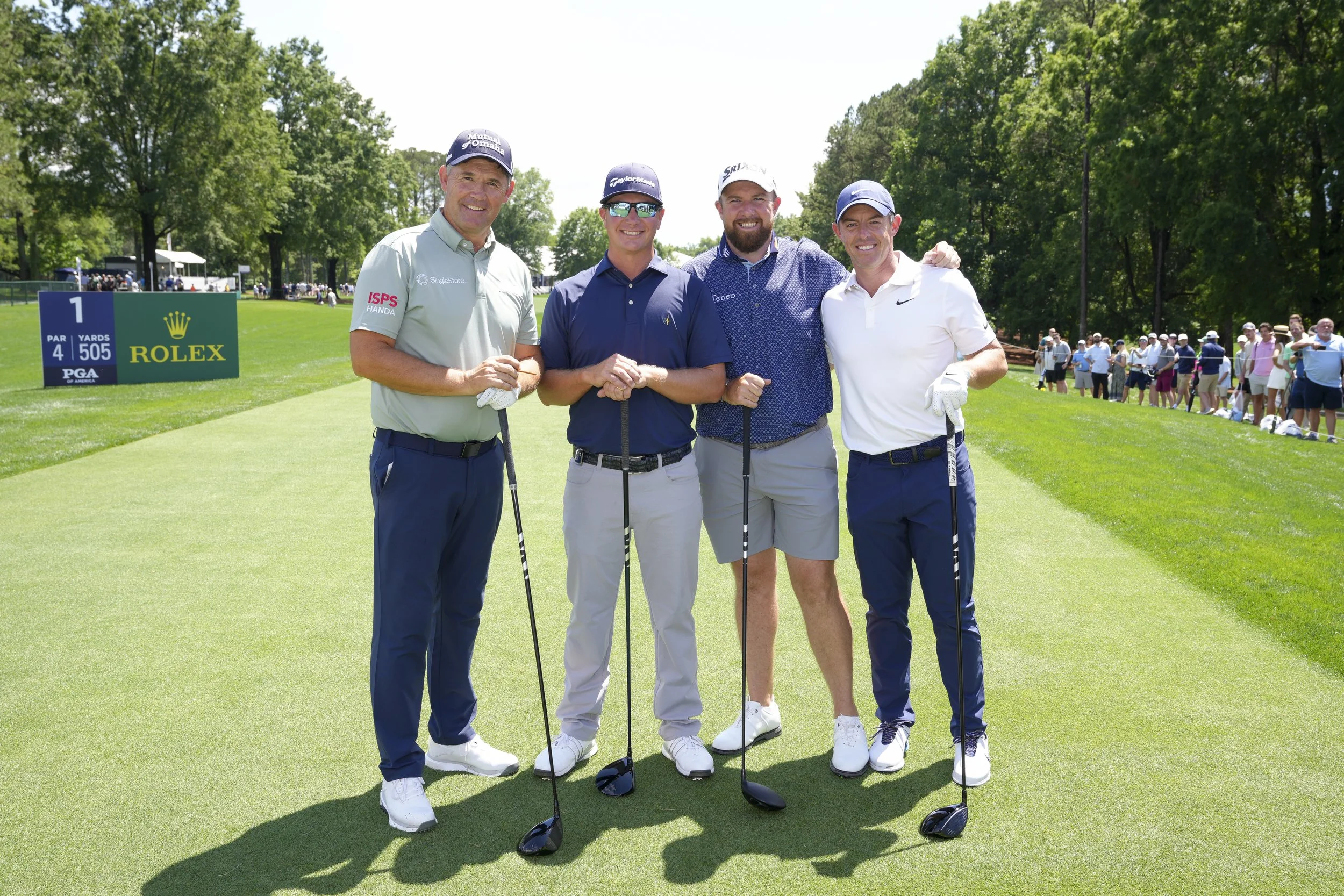
Padraig Harrington, Michael Kartrude, Shane Lowry, and Rory McIlroy pose together on the first hole tee box during the PGA Championship Practice Round at Quail Hollow Club on Tuesday, May 13, 2025 in Charlotte, North Carolina. (Photo by Darren Carroll/PGA of America)
Pádraig Harrington is as flummoxed as the next man about the diminishing Irish presence on tour, but he believes that our budding stars need to see one of their own make the breakthrough rather than looking to the Major winners for inspiration.
Irish golfers have captured 11 Major titles since 2007, but with Tom McKibbin the only Irish player under 30 with a full DP World Tour card this year, even a three-time Major champion like Harrington is at a loss to explain what’s going on.
The success of Harrington, Rory McIlroy, Shane Lowry, Darren Clarke and Graeme McDowell over the past 30 years is a massive achievement for Irish golf.
But the days when there were as many as 15 Irishmen teeing it up regularly on what is now the DP World Tour are clearly a thing of the past.
The tour is now far more international and cut-throat than it was 20 years ago, but with our Scottish counterparts enjoying great success again and the Danes and French hugely increasing their tour presence in recent years, Ireland is lagging far behind.
The situation hit home for Harrington on his recent four-event trip to the Middle East, and while he had McIlroy, Lowry or McKibbin for company for the first two events in Dubai, he was the only Irishman in action in Bahrain and Qatar.
“It's incredible,” said Harrington. “There are plenty of Irish people on tour. Loads of caddies. Physios. But it is a very common question.
“We played the event in Bahrain, and there's this area that has maybe 15 different restaurants, it's like a food court, but a little higher end, and it was like the European Tour Players’ Lounge at night.
“I’d be sitting there with Ronan, and a couple of caddies, and you look over, and there's 10 French guys at this table, and 12 Spanish guys at that table, and eight Scottish guys, all in their little groups. And you're going, that used to be us, you know.
“There used to be 15 guys when I came on tour. So why? Could it be just cyclical? It could be just that's the way it is. It could be the fact that there are so many more Scandinavians and even Eastern Europeans squeezing guys out of places. “If you've got 12 French, there were only two French guys on back when I started. So that's 10 more spots gone.
“But then you look at the Scots, and you say, well, they've got 10 guys on the tour at the moment, but go back four or five years, maybe 10 years ago, and they were tearing their hair out about how poorly they were doing relative to Ireland. So there are definitely cycles in this. There definitely are.
“I'd love to tell you, I have the answer that would be simple. I could suggest things and say, well, maybe stay amateur a little longer, and be able to dominate in the amateur game for a longer period of time. But that doesn't work.

Conor Purcell
“Guys have turned pro quickly and played well. Turning pro when you're hot is a good thing. I do think it was really difficult on Conor Purcell last year, being the only Irish guy on tour.
“There’s a good bunch of Irish on the Challenge Tour, and that could be the start as long as they're getting off it. If you can get two or three guys getting up on the main tour at the same time....”
Harrington does not see a lack of quality as the problem. He won his first Major when he saw Michael Campbell win the US Open and thought, 'Hold on, I’m as good as him'.
Yes, he has three Majors, McIlroy has five and Clarke, McDowell and Lowry have one each. But he believes that seeing your peers succeed, rather than the Irish superstars, might be the solution.
“I always go out of my way to try a play with the young guys at the Open or the Irish Open or something like that. I’m always trying to figure it out, but there's not one personality or one game there.
“You can't turn around and say they, they don't have a good enough short game, they're not hard enough. That's not true. There are hard ones, there are tough ones. There are great thinkers, there are bad thinkers. There’s a mixture of people and styles.
“So you can't turn around and say that we're producing one-dimensional players and that they're not capable. I'm hoping it's just cyclical. And let's face it, we're still punching well above our weight in terms of performance. We're just not pushing in terms of numbers.
“Hopefully, in five years’ time, there'll be 10 Irish guys on tour, and we’ll all be going, I told you so, and I knew we needed to do this.
“But golf is a crazy game, it's just such a hard game to put your finger on it.”
Believing you belong is key for Harrington, who got his card at the 1995 Qualifying School and went on to win the Spanish Open in his ninth start as a professional.
“There’s a minimum standard required physically to play the game, and the rest of it is, do they believe they belong?” the Dubliner explained.
“Are they comfortable out there? You know, you can get a bad start that really knocks you back. It's different for everybody. But I will say the most important thing is that if the current crop sees one of their peers being successful, then they'll go, 'I'm as good as him.'
“If they were trying to be Major winners, maybe myself and the other guys who won the Majors are role models. But at the moment, we're trying to get guys out on tour, and there aren't very many role models for them.
“As Major winners, maybe we are too far detached from those lads, and they need to see their friends, their peers, actually getting out there and doing it, and that will bring the others along.
“And that's probably what we're seeing with the French and the Danish and all those systems. The Spanish. They have guys that they're playing with week in, week out, who are getting on tour, who are winning on tour, and that just makes it so much more realistic for them.
“So then let's hope that one or two guys get through, and then the others go, ‘Yeah, I can see that. I'll do that.”